1
AI Multiplies Output — Mastery Decides by How Much
55%
faster task completion in a controlled GitHub Copilot study — 1h11m vs. 2h41m for the identical task
GitHub's randomized trial (n=95) found developers using Copilot finished a real coding task 55% faster, with a higher completion rate, at strong statistical significance. That's the floor of what's available right now to anyone who picks the tools up.
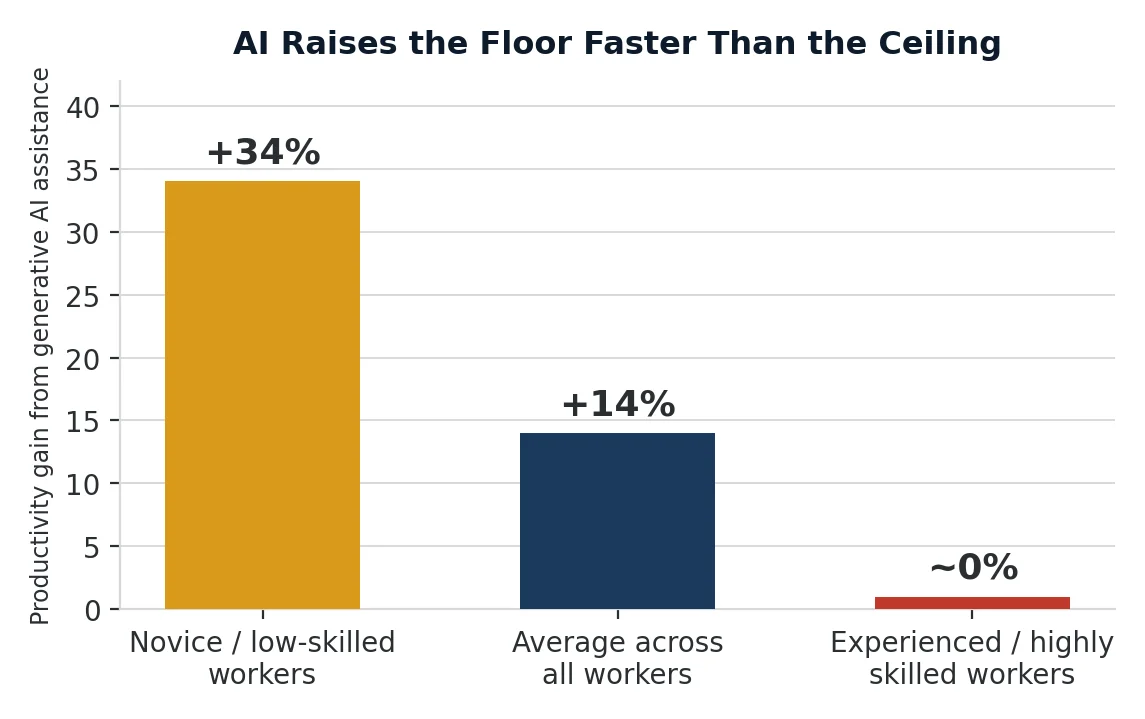
But the gains aren't even. Brynjolfsson, Li & Raymond's NBER study of 5,179 workers found generative AI assistance lifted novice performance by 34% while experienced, highly-skilled workers gained almost nothing on average. AI raises the floor on its own. Raising your own ceiling above that floor is the actual skill this lesson is about.
2
Where to Keep a Human in the Loop
19% slower
how much AI tools actually slowed down experienced developers on complex, familiar codebases — they'd predicted 24% faster
METR's 2025 controlled study of 16 seasoned open-source contributors found the slowdown came from time spent reviewing and correcting AI suggestions in contexts where the human already had more context than the model did. The tool wasn't useless — it was being pointed at the wrong job.
Worse, the danger isn't visible from the inside: Stanford's Perry et al. found developers using AI assistants wrote measurably less secure code while being more confident it was secure than developers working without one. Overconfidence, not incapability, is the actual failure mode — keep a human reviewing exactly where you'd already want a second pair of eyes: security-sensitive code and anything in a codebase you understand better than the model does.
84%
of developers are using or planning to use AI tools (Stack Overflow, 2025) — up from 76% the year before
56%
wage premium for AI-skilled workers in 2024 (PwC Global AI Jobs Barometer) — more than double the 25% premium measured the year before
29%
of developers say they actually trust AI output — down from 40%. Rising adoption and falling blind trust are both the correct response
Stack Overflow Developer Survey (2025) · PwC Global AI Jobs Barometer, ~1B job ads analyzed (2025).
3
The Management Lesson, Without the Politics

- This is Lesson 5 again, with the hard part removed. Leadership wasn't for everyone because managing people means managing politics, ego, and emotional baggage on top of the actual work. Directing AI well is the same leverage skill — multiplying effort through something else's labor — minus all of that. It doesn't have a bad day, doesn't need credit, and isn't reading the room for slights.
- That makes it available to everyone, including people who correctly opted out of managing humans. You don't need political skill to direct a model. You do need the same things that made a good manager good: clear direction, well-specified work, and checking the output.
- Experiment constantly. The floor moves every few months. “I tried it and it wasn't good enough” has a shelf life measured in weeks, not years.
- Point it at the right jobs. Novel, well-specified, unfamiliar-to-you territory is where the floor-raising effect is real. Deeply familiar, complex, security-sensitive territory is where you already out-context the model — that's where METR's slowdown and Perry's overconfidence finding both live.
- Review its output the way you'd review a sharp, fast, overconfident junior's pull request. Assume competence. Verify everything. Never skip the diff.
Bottom Line
Engineers who multiply their effort with AI will be the ones who succeed. You can wait to be replaced, or you can become the one directing it — there isn't a comfortable third option.
The data says the wave is already underneath most of the industry, even where it's still invisible: 84% of developers are using or planning to use these tools, and the wage premium for doing it well has more than doubled in a single year. None of that means turning your judgment off. The same research that proves the upside also shows exactly where the downside lives — complex, familiar codebases where you already know more than the model, and security-sensitive work where overconfidence is the real vulnerability, not incapability. The skill worth building isn't blind adoption; it's the same direction-and-review discipline a good manager already has, minus the office politics that made Lesson 5's path optional for plenty of good engineers. This path isn't optional. Ride it, or it rides over you.
Sources: Peng et al., “The Impact of AI on Developer Productivity: Evidence from GitHub Copilot,” GitHub/Microsoft/MIT (2023) · Brynjolfsson, Li & Raymond, “Generative AI at Work,” NBER Working Paper 31161 (2023) · METR, controlled study of AI coding-tool impact on experienced open-source developers (2025) · Perry, Srivastava, Kumar & Boneh, “Do Users Write More Insecure Code with AI Assistants?,” Stanford (2023) · Stack Overflow Developer Survey (2025) · PwC Global AI Jobs Barometer (2025).