1
Without a Rule, Judgment Is Noisier Than You'd Guess
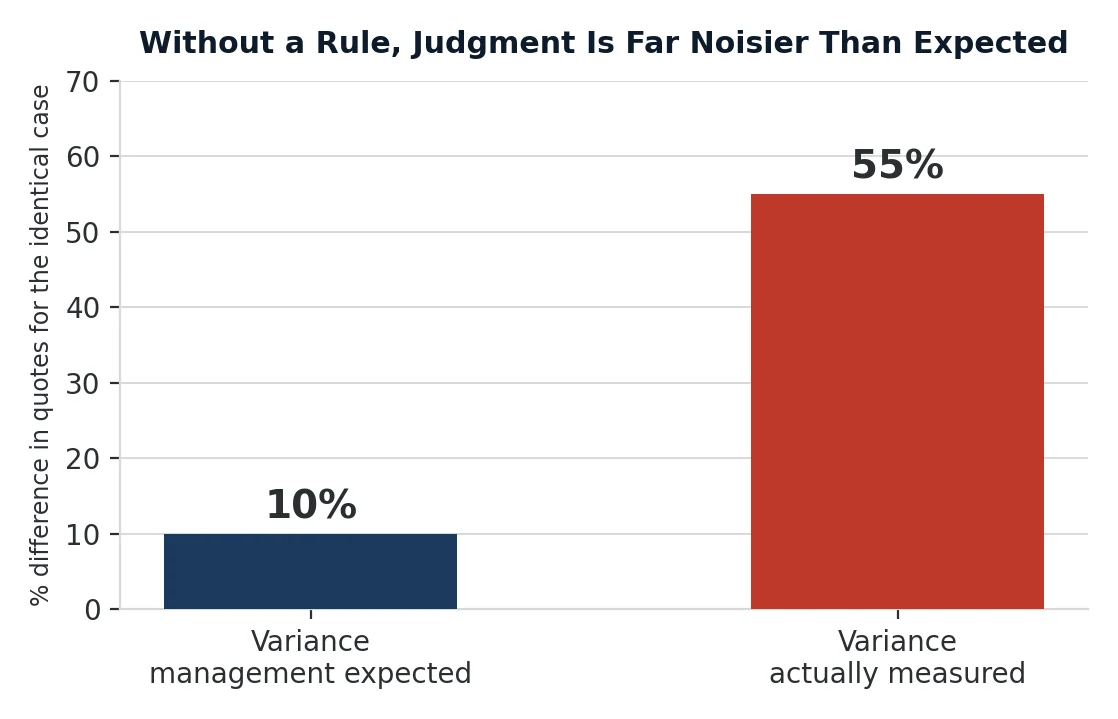
55%
how much insurance underwriters' quotes varied for the exact same case — management expected about 10%
Kahneman, Sibony & Sunstein's Noise (2021): handed identical case files, professional underwriters at the same firm produced wildly different numbers — one might quote $9,500, another $16,700, for the same risk. The gap wasn't bias toward one answer; it was pure, unwanted inconsistency, the kind explicit rules and stated principles exist to remove.
This is the case for having your own design principles even if you have zero interest in being a visionary: without one, your own judgment is quietly inconsistent in ways you can't see from the inside — the same review criteria applied differently depending on the day, the mood, or who's asking.
2
Vision Isn't Just for Iconoclasts
10 → 1
Dieter Rams' ten principles for good design, openly credited by Jony Ive as the starting point for Apple's entire aesthetic
Rams wrote them in the 1970s for consumer electronics. They translated cleanly to hardware, then to software, then to an entire design language that shaped the most valuable company in the world. The principles weren't decoration — they were a compression of years of judgment into rules someone else could actually apply.
You don't have to want to be Robert Greene's iconoclast or reinvent an industry for this to be worth doing. A clear personal design principle changes what you do in a code review on an ordinary Tuesday — that's the entire value, whether or not anyone ever calls you visionary for it.
3
A Condensed Example: Twenty Years of One Operating Principle
The Promethean Way
Build powerful things and the accountability structure that comes with them — together, not sequentially.
Prometheus stole fire from the gods and gave it to humanity — the founding act of civilization, and Zeus punished him for it without restraint or a method attached. Read straight, the myth is a warning: transformative power handed over with no accountability structure is its own punishment waiting to happen. The Covenant project's governance-first approach to AI is this principle applied directly — not “pause AI” and not “leave it to one company,” but power and method delivered as one package.
Bringing Fire With Foresight
Raw power without method — without “modus” — is dangerous chaos.
Modus Promethean's mission statement, almost verbatim. AI is the new fire: world-changing, and currently being handed out the way the gods originally tried to keep it — reserved, ungoverned, and without instructions. The principle doesn't say don't take the fire. It says don't take it without the method for carrying it safely.
The Big Red Button
Give users the big red button that says, “do my job for me.”
JP's core design directive for over 20 years, stated in one sentence: free people from clerical work so they can do the parts of their job only a person can do — create, grow their business, provide service to someone else. Notice how specific this is compared to “be user-centric” or “build great products.” It's concrete enough to settle an actual design argument: if a feature doesn't remove clerical burden, it isn't the feature that matters most.
Three different statements, one structure underneath: a stance on power and responsibility (Promethean Way), a mission translation of that stance (Bringing Fire With Foresight), and a single concrete design rule that operationalizes it on an ordinary Tuesday (the Big Red Button). That's what a usable personal principle looks like — specific enough to resolve a real disagreement, general enough to apply for twenty years.
Bottom Line
Engineers with vision shape the world. The rest of the value is available to everyone else too: a stated principle is what keeps your own judgment from being noisier than you realize.
You don't need a manifesto. You need something closer to the Big Red Button — a sentence specific enough to actually resolve a design argument, not a vague value statement that agrees with everything and decides nothing. The raw material for that sentence is whatever you've read, watched, and lived that gave you a real opinion about where things are going — which is exactly why the previous lesson on science fiction isn't a detour from this one. Read enough imagined futures, decide what you actually believe about the one you're building toward, and write it down in one sentence you can apply in a code review. That's the whole exercise, and it scales from a single engineer's personal taste to twenty years of an actual company's architecture.
Sources: Kahneman, Sibony & Sunstein, Noise: A Flaw in Human Judgment (2021) · Dieter Rams, “Ten Principles for Good Design” (1970s), and Jonathan Ive's public attribution of Apple's design language to Rams · Prometheus myth, classical sources (Hesiod, Aeschylus) · Covenant (covenant.to) and Modus Promethean (modpx.dev) project mission framing, JP Howlett.