1
Fiction Builds the Target Before Engineering Hits It
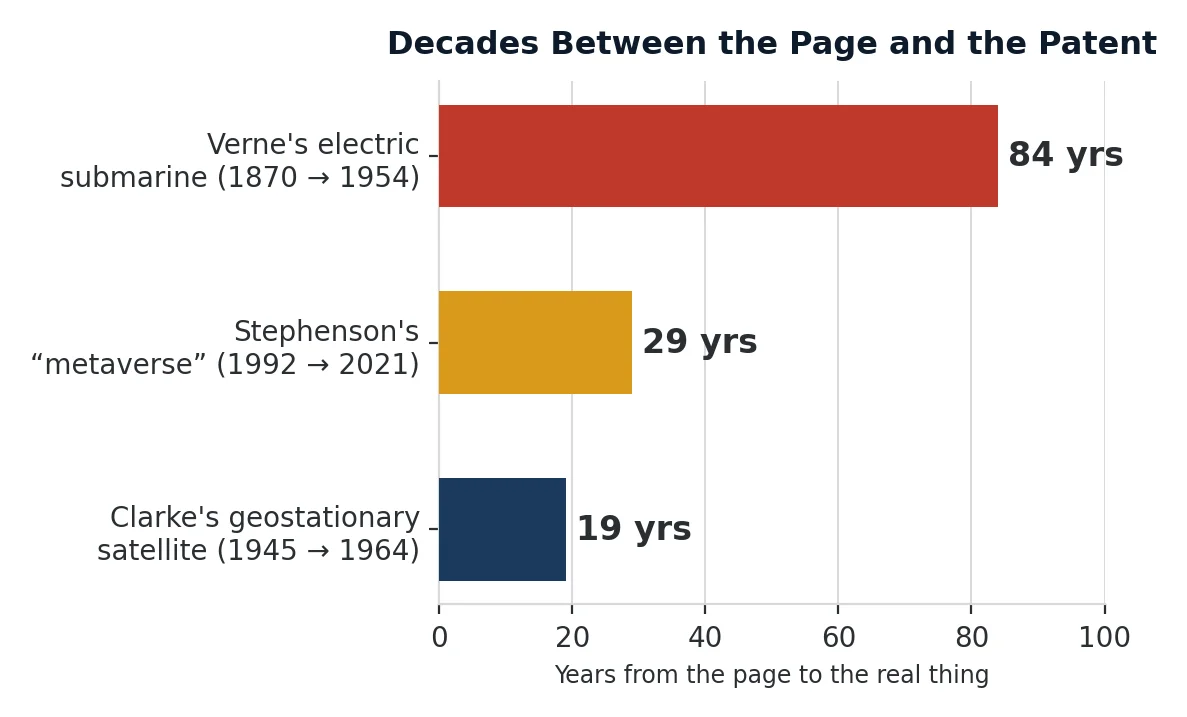
19 yrs
from Arthur C. Clarke's 1945 paper to the first true geostationary satellite
Clarke's “Extra-Terrestrial Relays” (Wireless World, 1945) worked out the orbital mechanics of geostationary communication satellites before rockets could put anything in orbit at all. Syncom 3 proved him right in 1964. The orbit itself is now officially named the Clarke Orbit.
Neal Stephenson coined the word “metaverse” in Snow Crash (1992). Twenty-nine years later, Facebook renamed its entire company after his word, not a new one of their own.
2
Even the Myths That Are Wrong Prove the Point
“Prior Art”
Samsung's actual 2011 legal argument against Apple: a tablet shown in 2001: A Space Odyssey (1968) predates the iPad by 42 years
The judge excluded the evidence on a procedural technicality — Samsung disclosed its intended use too late — not because the comparison was wrong. Kubrick and Clarke's fictional “Newspad” really did look like an iPad, four decades early.
Even the most famous version of this genre of story is itself a myth worth correcting: Martin Cooper, who built the first handheld cell phone at Motorola, has said directly that Star Trek's communicator wasn't his inspiration — Dick Tracy's wrist radio was. The popular story swapped one fictional gadget for another more famous one. Either way, the mechanism is the same: a fictional device gave an engineer a concrete target years before the engineering existed to hit it.
1920
Karel Čapek's play R.U.R. introduces the word “robot” — decades before the first one was built
2009
Intel appoints its first official corporate futurist, using science-fiction narratives as a formal R&D planning method
84 yrs
from Verne's fictional electric submarine (1870) to the USS Nautilus — named directly after it
Čapek, R.U.R. (1920) · Brian David Johnson, Intel futurist and originator of “science fiction prototyping” (2009–) · Verne, Twenty Thousand Leagues Under the Sea (1870); USS Nautilus commissioned 1954.
3
Read for the Premise, Not the Plot

- Good science fiction is a worked example of second- and third-order consequences. It doesn't just imagine the gadget — it imagines what the gadget does to the people, the institutions, and the power structures around it. That's exactly the muscle engineering school doesn't train.
- You don't need to want to change the world to benefit. Intel didn't hire a futurist because they wanted to write novels — they did it because imagining the future in narrative form produces better near-term roadmap decisions than a spreadsheet does.
- Keep a running list of premises, not predictions. The interesting part of Clarke's paper wasn't the satellite — it was the assumption underneath it (objects at a specific altitude stay fixed relative to the ground). Mine fiction for the assumption, not the prop.
- This is the raw material for the next lesson. You can't have a personal vision or a set of design principles you actually believe in if you've never read anyone else's attempt to picture where things are going.
Bottom Line
Engineers who read science fiction aren't indulging a hobby adjacent to the job — they're rehearsing the actual skill of building toward a target that doesn't exist yet.
Clarke worked out the geometry of communications satellites nineteen years before a rocket could test it. Stephenson named a category of product that didn't exist for three decades. Verne's imagined submarine got its name handed directly to the U.S. Navy's first nuclear one. Even the famous story that turns out to be wrong — Cooper and the communicator — only swaps in a different fictional gadget, because the underlying mechanism is real regardless of which story you tell about it: fiction gives engineers a concrete, specific, arguable target long before the engineering exists to reach it. You don't have to want to be the next Robert Greene of robotics for this to matter. You just have to want to see further down the road than the current sprint, which is exactly what the next lesson is about turning into something usable.
Sources: Clarke, “Extra-Terrestrial Relays,” Wireless World (1945) · Stephenson, Snow Crash (1992) · Verne, Twenty Thousand Leagues Under the Sea (1870) · Čapek, R.U.R. (1920) · Samsung v. Apple, N.D. Cal. (2011–2012), “Newspad”/2001: A Space Odyssey prior-art briefing · Brian David Johnson, “Science Fiction Prototyping” (Intel, 2009–); Cooper's own account of the Dick Tracy influence, multiple interviews including his memoir.