1
The Peter Principle Is Empirically Confirmed, Not Just a Joke
53,035 / 214
sales employees, across 214 firms, in the largest empirical test of the Peter Principle to date
Benson, Li & Shue (Quarterly Journal of Economics, 2019) tracked which salespeople got promoted to manager and how those managers actually performed. The same sales skill that earned the promotion predicted worse performance as a manager — and firms kept promoting on sales performance anyway, because it was the only signal they had.
The researchers' conclusion wasn't “don't promote your best people.” It was that current-job performance and managerial potential are different variables, and most companies only measure one of them before handing someone a team.
2
Most People Aren't Built for This — That's Normal
1 in 10
people, per Gallup's research, possess the natural talent to manage a team well
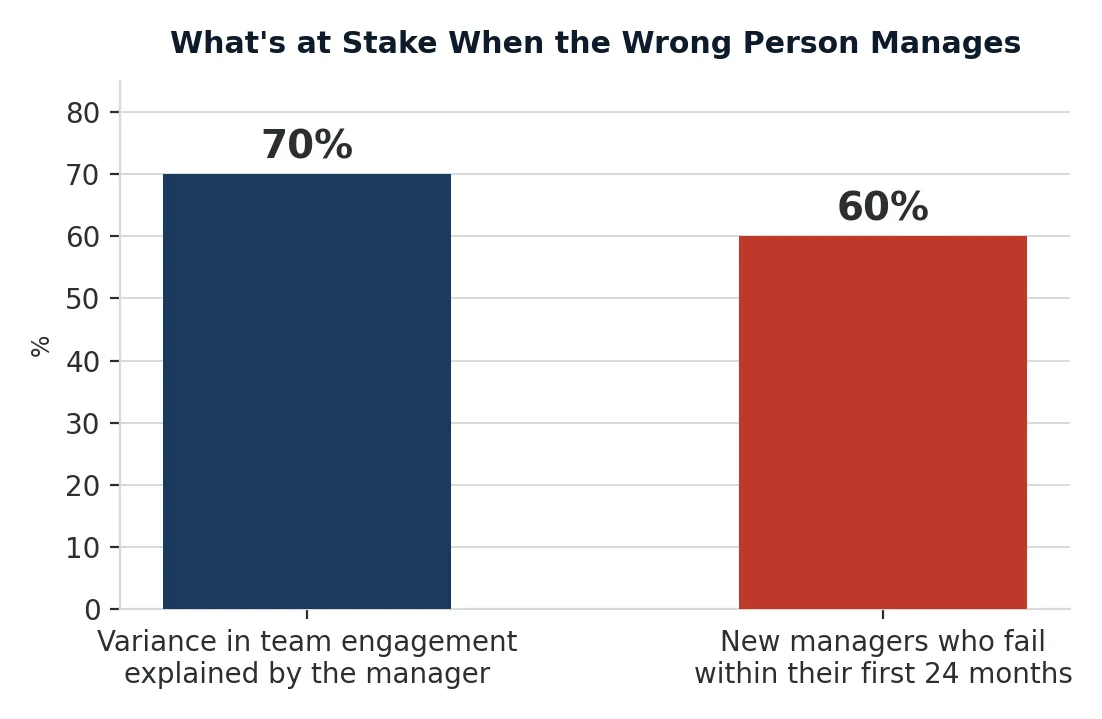
That's not a knock on the other nine — it means management draws on a different set of instincts than almost any individual-contributor job does. Gallup's parallel finding: the manager accounts for roughly 70% of the variance in a team's engagement scores. Who's in the seat matters more than almost anything else about the job.
The consequence shows up fast: an estimated 60% of new managers fail within their first 24 months (CEB/Gartner) — often because no one checked for aptitude before handing over the title.
1970s
when companies began formalizing dual-career ladders, after watching top technical performers get promoted out of the work they were good at
DuPont · 3M
early adopters (1930s and 1970s, respectively) of a parallel technical track that paid and advanced like management did
Senior ≠ Manager
a senior or team-lead title is usually still an individual-contributor role — recognition without requiring the career switch
Dual-career-ladder design literature, technical/management track research (1970s formalization, with earlier precedents at DuPont and 3M); Bell Labs' “Member of Technical Staff” title predates the modern “Staff/Principal Engineer” ladder by decades.
Pay does tend to rise with headcount managed — research on span of control finds compensation rising with the number of direct reports, just less than proportionally (Journal of Labor Economics, 2002). One could reasonably argue a manager shouldn't be paid more simply as a rollup of who reports to them rather than for the judgment itself. The standard economic counter is tournament theory (Lazear & Rosen, 1981): steep pay gaps between levels work as an incentive system for everyone below the gap, not just a price on the person who got promoted — and for the most part, that's simply the structure most organizations run on. The good news is that some organizations have already separated the two: at Google, the median total comp for an L6 Staff Engineer ($579,576) is essentially identical to an L6 Engineering Manager ($590,551) — Levels.fyi, 2026. Good engineering orgs already pay the ladder, not the rollup.
3
Make the Choice on Purpose

- The first step up is usually still your old job. Senior, lead, staff — these titles typically recognize your talent without making you responsible for anyone else's output. Take them without treating them as a referendum on whether you want to manage.
- When the real offer comes, ask the right question. Not “am I good enough to do this” — almost everyone offered the role is. Ask whether you'd find it rewarding to make other people's output your primary job, day after day.
- Saying no is not capping your career. The dual-ladder exists precisely so technical excellence doesn't have to convert into people-management to keep being rewarded. Companies that don't offer one are behind, not you.
- If you say yes, know what you're trading. The depth and craft that made you excellent as an individual contributor are not what the new job measures — delegation, development, and organizational navigation are.
- Pilot it if you can. Lead one project, mentor one person, before committing to the full title. Most companies aren't doing this vetting for you — the 60% failure rate says so.
Bottom Line
Being offered leadership is a compliment about your past performance. Whether to accept it should be a decision about your future one — and those are not the same question.
The Peter Principle isn't folk wisdom; it's a measured pattern in tens of thousands of real promotions, and the cost of getting the mismatch wrong is large enough that researchers call it economically significant. Most people, including most excellent individual contributors, are not naturally wired for people-management — that's not a deficiency, it's just a different skill, and only about one in ten people walk in with it already built. The fix already exists: dual-career ladders have let people choose deep technical seniority over management for fifty years, on purpose, as designed policy rather than as a consolation prize. Take the senior title. Take the lead role. When the management offer actually comes, decide on the only question that matters — not whether you can do it, but whether you'd want to.
Sources: Benson, Li & Shue, “Promotions and the Peter Principle,” Quarterly Journal of Economics 134(4), 2019 · Gallup, “State of the American Manager,” managers and the 70% engagement-variance finding · CEB/Gartner, first-time manager failure-rate research · dual-career-ladder design literature, 1970s formalization with DuPont (1930s) and 3M (1970s) precedents; Bell Labs “Member of Technical Staff” designation · span-of-control compensation research, Journal of Labor Economics (2002) · Lazear & Rosen, “Rank-Order Tournaments as Optimum Labor Contracts,” Journal of Political Economy (1981) · Levels.fyi compensation data, Google L6 Staff Engineer vs. Engineering Manager, 2026.