1
Negative Words Travel Farther Than Positive Ones
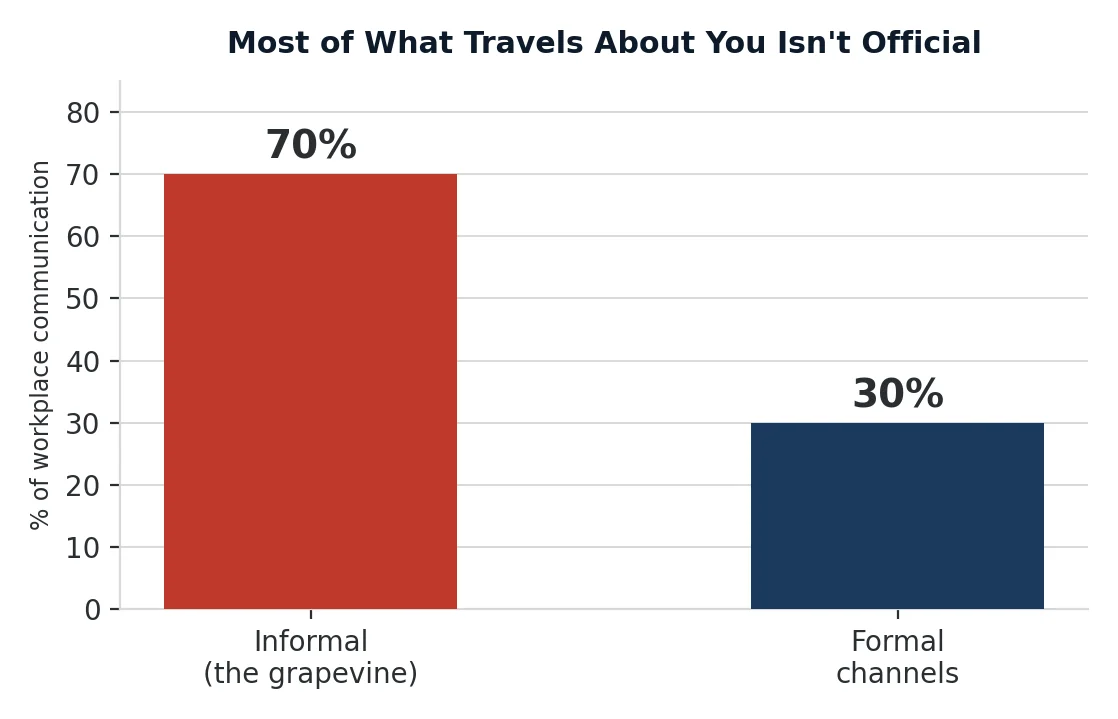
70%
of workplace communication moves through informal channels — the grapevine, not the org chart
An estimated 70% of what circulates inside an organization never touches a memo, an email thread, or a meeting agenda (American Management Association). It travels person to person, and it travels for free.
It doesn't travel evenly. People detect, remember, and repeat negative information faster than positive information — a documented negativity bias in social transmission. Urban legends carry roughly three times as much hazard content as benefit content for exactly this reason. An unflattering comment about a colleague is simply more likely to complete the trip back to them than a compliment is.
2
Political Skill Is a Measured Trait, Not a Dirty Word
4 Dimensions
social astuteness, interpersonal influence, networking ability, apparent sincerity — the measured components of “political skill”
Ferris et al.'s political skill construct predicts career success, performance ratings, and personal reputation — even after controlling for IQ and the Big Five personality traits (Munyon et al. meta-analysis). It is a real, learnable skill, distinct from manipulation.
Notice that apparent sincerity is one of the four official dimensions, not an afterthought. The version of this skill that works long-term requires actually meaning what you project — the version that doesn't is the one that turns into someone else's cautionary story.
65%
of everyday conversation, across cultures, is social talk — gossip in its broad sense. It's not an office quirk; it's how conversation works
75–95%
grapevine accuracy range — but no message has a named author, so no one is accountable when it lands in the wrong 5–25%
Solutions > Complaints
“promotive voice” (raising a problem with a fix attached) is rated significantly higher by managers than raising the problem alone
Dunbar, “Gossip in Evolutionary Perspective,” Review of General Psychology (2004) · American Management Association grapevine research · Liang, Farh & Farh, promotive/prohibitive voice research, Academy of Management Journal (2012).
3
Address It Directly. Bring a Fix.
- Speak about people only as you'd speak to them. Given how much travels through informal channels, treat every comment as if it will eventually reach its subject — because the data says it's more likely to than not.
- Go to the person before you go around them. Raise concerns about someone's work directly and objectively first; reserve escalation for when that direct conversation genuinely fails, not as the first move.
- Imagine you're the one being confronted. Frame the concern the way you'd want it framed if someone were raising it about you — objective, specific, not personal.
- Never present a problem without a proposed fix. This is not just etiquette — promotive voice is measurably better received by management than the same complaint without a solution attached.
- Play the game on purpose. Political skill is a real, trainable, career-predicting trait. Refusing to engage with it doesn't make you above the game — it just means someone with the skill plays it on you instead.
Bottom Line
This is one of the real ways people ascend, and one of the real ways people get sunk — the difference is whether you play the game deliberately or pretend you're not playing at all.
Most of what's said about you moves through channels no one is accountable for, and the negative version of any story travels faster and sticks harder than the positive one. That alone is reason enough to hold a simple standard: don't say it if you wouldn't say it to them. When you do have a real concern about someone's work, the data favors going to them directly, staying objective, and showing up with a fix rather than just a complaint — that combination is what gets you rated well by the people above you, not the complaint by itself. Political skill is measurable, learnable, and genuinely predicts who advances, independent of raw intelligence. Engage with it carefully and sincerely, and it's how you end up running the room. Mishandle it — trash someone behind their back, escalate before you've tried direct, show up with problems and no answers — and you become the agenda item in someone else's meeting after the meeting.
Sources: American Management Association, workplace grapevine communication research · Hilbig & Zettler / Heath et al., negativity bias in the social transmission of rumors and urban legends · Dunbar, “Gossip in Evolutionary Perspective,” Review of General Psychology (2004) · Ferris, Treadway, Perrewé et al., political skill construct · Munyon, Summers, Thompson & Ferris, “Political Skill and Work Outcomes: A Theoretical Extension, Meta-Analytic Investigation, and Agenda for the Future,” Personnel Psychology (2015) · Liang, Farh & Farh, promotive/prohibitive employee voice research, Academy of Management Journal (2012). Grapevine accuracy and volume figures are widely-cited industry/AMA estimates rather than a single controlled study.