1
Video Adds a Dimension — Not the Full Bandwidth
7-38-55
the most misquoted ratio in communication research
Mehrabian's 1967 studies are usually summarized as “93% of communication is nonverbal.” That's not what he found. His two small studies (30–37 women, lab setting) measured only how listeners judge a speaker's emotional attitude from a single word — not factual or technical communication in general. The ratio doesn't generalize the way the internet thinks it does.
What's actually true, and doesn't need a misquoted study to prove it: video shows a face and a torso. It strips out everything below the shoulders, peripheral awareness of the room, physical distance and orientation, and the half-second glances people exchange that never cross a webcam's frame.
2
The Room Has an In-Crowd
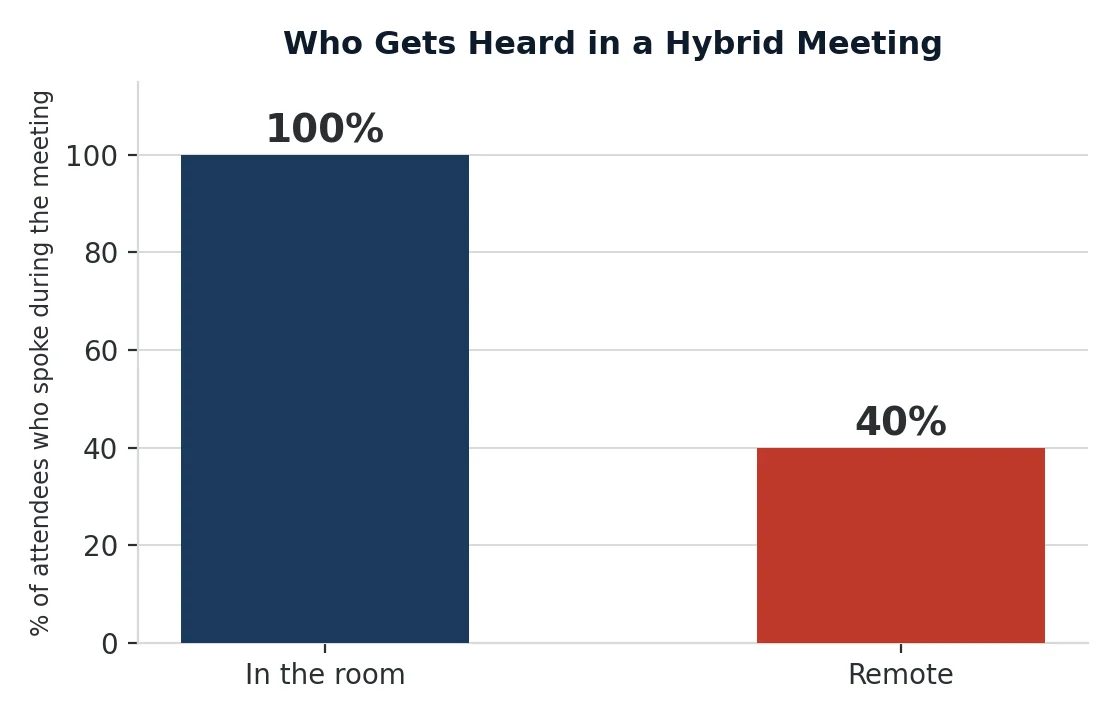
100% vs. 40%
share of in-room vs. remote attendees who spoke during a studied hybrid meeting
Every person physically present spoke at some point. Less than half the remote attendees did. The people sharing a room share a channel — the mood, the side glance, the eye-roll — that a video tile simply doesn't carry, and that channel makes them a temporary in-group whether anyone intends it or not.
I once sat in a meeting where a remote participant was going on at length, and a senior manager — out of the camera's view — picked up a pair of scissors and silently mimed stabbing himself in the chest. The room cracked up. The remote participant never knew it happened, and never knew it had quietly cost him a little standing with that group.
+13%
performance gain measured among remote workers in Stanford's Ctrip experiment
Promoted less
despite outperforming, remote workers' promotion rate (conditional on performance) fell
Unscheduled.
Informal.
Confidential.
the academic definition of “the meeting after the meeting” — where real decisions often get made, or unmade
Bloom, Liang, Roberts & Ying, “Does Working from Home Work?”, Quarterly Journal of Economics (2015) · Meinecke & Handke, “The Meeting After the Meeting,” Journal of Management Inquiry (2023).
3
Read the Room You're Actually In

- Show up in person when it's a relationship, a negotiation, or a first impression. Face-to-face negotiations are consistently measured as less hostile and more profitable than virtual ones — the stakes are exactly where the lost bandwidth hurts most.
- In a group setting, notice who's actually in the room together. They have a back-channel you don't, even when no one is being deliberately exclusive about it. It's a structural fact of the seating chart, not a conspiracy.
- The meeting after the meeting is real. If you're remote, assume the scheduled call wasn't the whole story. Follow up one-on-one with someone who was in the room rather than trusting the minutes.
- Not every meeting earns this effort. Status updates, large broadcasts, and meetings where you're genuinely peripheral are fine on video — save the travel and the social capital for where physical presence actually changes the outcome.
- Match the channel to the stakes: audio carries tone, video adds face, and only the room carries the rest — the posture, the proxemics, the joke nobody says out loud.
Bottom Line
Video conferencing solved the distance problem. It did not solve the bandwidth problem, and it quietly created a tier system — the room, and everyone else.
None of this is an argument against remote work, which by the data is more productive, not less. It's an argument for knowing exactly what you're trading away when the relationship, the negotiation, or the politics matter and you take it on a screen anyway. The people physically present in a room form a temporary in-group the moment the door closes, whether or not anyone there intends to exclude the people who aren't. The official meeting is rarely the whole transaction — there is very often a meeting after the meeting, and it happens in the room, not on the call. Use video for what it's good at: information transfer at scale, with low stakes and low ambiguity. Show up in person for everything that depends on trust.
Sources: Mehrabian, “Decoding of Inconsistent Communications,” JPSP (1967) · Bailenson, “Nonverbal Overload: A Theoretical Argument for the Causes of Zoom Fatigue,” Technology, Mind, and Behavior (2021) · Stuhlmacher & Citera, “Hostile Behavior and Profit in Virtual Negotiation: A Meta-Analysis,” Journal of Business and Psychology (2005) · Bloom, Liang, Roberts & Ying, “Does Working from Home Work? Evidence from a Chinese Experiment,” Quarterly Journal of Economics (2015) · Meinecke & Handke, “The Meeting After the Meeting: A Conceptualization and Process Model,” Journal of Management Inquiry (2023) · hybrid-meeting contribution-rate figure drawn from published agile/hybrid-collaboration field studies; treat as illustrative of a documented pattern rather than a single universal ratio.