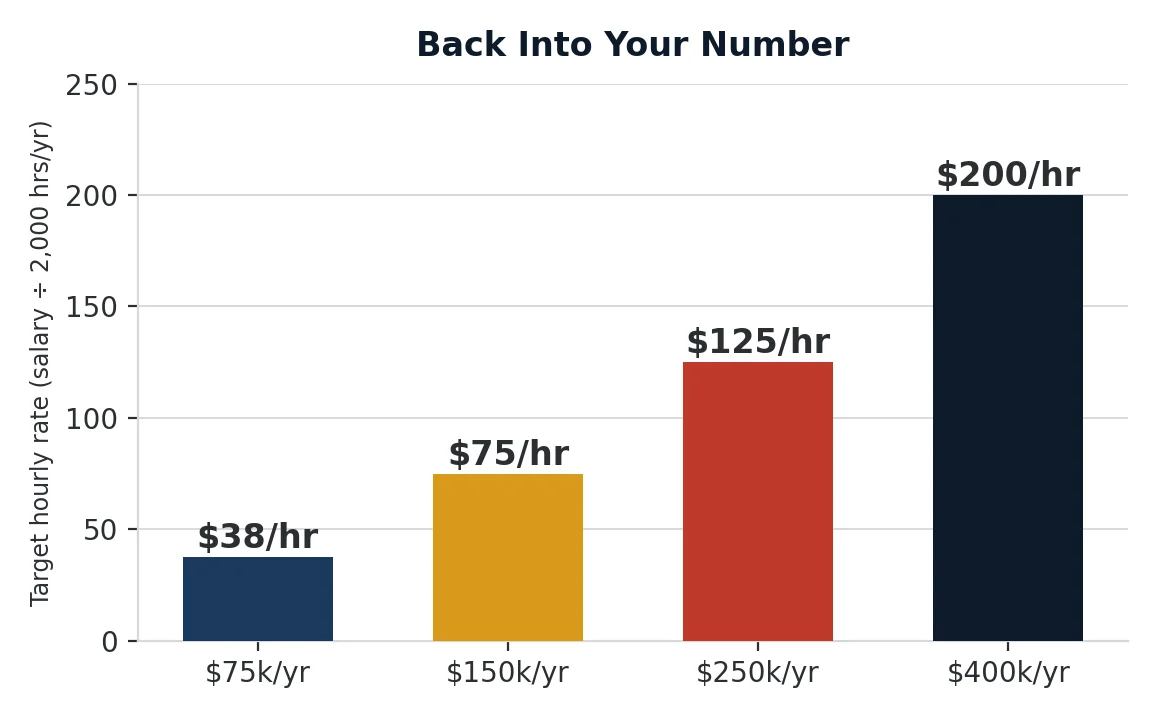
÷2,000
hours in a working year (40 hrs/wk × 50 weeks) — the simplest tool you have to price your own hour
Decide what you think you should be making in a year. Divide by 2,000. That number is your benchmark — not a hard floor you refuse to go below, but a number you keep in your head every time you're deciding whether something is worth your hour.
This isn't only a freelance-rate exercise. Apply it to recreation too: if an activity, a commute, or a chore costs you hours you'd otherwise bill at your number, you're paying for it whether money changes hands or not.
2
An Open Calendar Signals a Cheap Hour
2 vs. 10
identical biscuits, rated more valuable from the jar with only 2 left than the jar with 10
Worchel, Lee & Adewole's classic scarcity experiment (1975): nothing about the product changed, only its apparent availability — and perceived value rose anyway. Bellezza, Paharia & Keinan (J. Consumer Research, 2017) found the same effect applied to people: someone who describes themselves as overworked and in-demand is rated as more competent, more skilled, and higher-status than someone who describes a relaxed schedule — even from identical underlying information.
When you don't have a full schedule yet, act like you do. If someone asks for a time to meet, don't say “anytime” — offer one or two specific windows. “Anytime” prices your hour at zero before the conversation even starts.
4,690
people across 6 studies: valuing time over money predicted greater happiness
+18%
longer that time-valuers spent socializing with a new peer, vs. money-valuers
1 yr later
time-valuing graduates were still happier than money-valuing peers
Whillans, Weidman & Dunn, “Valuing Time Over Money Is Associated With Greater Happiness” (2016); Whillans & Dunn, “Valuing Time Over Money Is Associated With Greater Social Connection” (2019); Whillans et al., Science Advances (2019) longitudinal graduate study.
3
Don't Let the Discipline Turn Into a Wall

- The benchmark is a filter, not a fence. Knowing your number doesn't mean you only take work that clears it — it means you know exactly what you're trading away when you take something that doesn't.
- Pricing your time correctly is what lets you fit more in. People who manage time well aren't the ones who say no to everything — they're the ones who've already cut the low-value hours, which leaves real room for the high-value ones.
- Make time for people on purpose. The research above runs against the instinct to retreat: the people who value time most highly are the ones who invest it in relationships more, not less — valuing your time and isolating yourself are not the same discipline.
- Treat your own leisure with the same respect. If you wouldn't give away a billable hour for free, don't give away your Saturday morning to something that doesn't deserve it either.
- Confidence reads as value — scarcity reads as confidence. A calendar that looks deliberate, even when it isn't full, does more for how your time is perceived than constant availability ever will.
Bottom Line
An abundance of time is the easiest thing in the world to undervalue — and the people around you will price it exactly as low as you let them.
Back into your number from what you think you should be earning in a year, and keep it in your head for work and for recreation alike. Treat your calendar like it already has structure, even when it doesn't: offer one or two times instead of “whenever,” because scarcity reads as competence whether the scarcity is real or simply well-presented. None of this is license to disappear. The data runs the opposite direction from the stereotype — the people who value their time most are also the ones who invest more of it in other people, not less. The goal isn't a fuller calendar or an emptier one. It's a calendar you priced on purpose.
Sources: Worchel, Lee & Adewole, “Effects of Supply and Demand on Ratings of Object Value”, JPSP (1975) · Bellezza, Paharia & Keinan, “Conspicuous Consumption of Time”, Journal of Consumer Research (2017) · Whillans, Weidman & Dunn, “Valuing Time Over Money Is Associated With Greater Happiness”, Social Psychological and Personality Science (2016) · Whillans & Dunn, “Valuing Time Over Money Is Associated With Greater Social Connection”, Journal of Social and Personal Relationships (2019) · Whillans et al., Science Advances (2019). Hourly-rate benchmarks are illustrative arithmetic (salary ÷ 2,000 hrs/yr), not a market survey.